
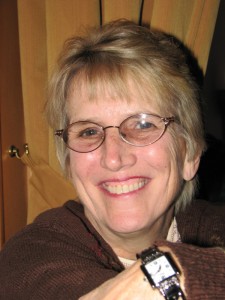
 One of my favorite parts of hosting a blog is being able to meet and interview new authors (maybe not “new,” but new to me). Today is one of the days when I get to introduce a new author. Carol McClain is … well, there’s no need for me to tell you who she is or what she does – she’s about to do it herself! Here’s Carol:
Please tell us a little about yourself.
I don’t fit the typical mold for anything. As a teen, this bothered me. As an adult, I’ve learned to celebrate my idiosyncrasies. I have a passion for learning. My dream in writing is to be such a credible author that I could ask to ride along with cops (like Castle) or EMTs (think Gabriella Dawson) or DAs (Jack McCoy) or brilliant diagnosticians (House). People would be pleased with my presence because they knew they’d get a thumbs up in my acknowledgements.
I love my bassoon, creating stained glass, running, and, of course, writing.
Fortunately, my husband is a bulwark. He’s stable and keeps me grounded.
Why did you start writing?
As you can tell from the first question, I’m a dreamer—and a TV addict of police and medical procedurals (which I don’t write.) As a child, I decided to write a spin-off of one of my favorite TV shows, The Little Rascals. That story bombed—don’t know why?—and I turned to creating plays. My friends and I would charge our folks a penny and they’d be forced to watch us perform my creations.
As an adult, I turned that into church plays. Then one day I decided to see if I could actually write a book. As of today, I’ve written four novels.
How did you select your genre?
I write what I call contemporary, but most people call it women’s fiction. It’s my favorite to read. It’s a vehicle for themes I hold dear.
On September 11, my second novel will be published. Waters of Separation deals with two intense themes. The primary one deals with economic slavery seen in child enslavement in the cocoa sector in the Ivory Coast. The intertwining theme deals with how one can overcome a devastating past. PA Anna Haas must come to grips with her mother’s suicide that killed the two sisters she had vowed to protect. When she discovers a young boy forced to work for his uncle, the past resurrects.
I hate that we blithely accept the economic servitude our overseas manufacturing creates.
My first book is funny. DWF: Divorced White Female deals with finding a sense of self, defining importance apart from a spouse. The protagonist—unsaved at the beginning—thinks a man, any man as long as he’s hot, can redeem her from her lonely life. Little does she know the Man she needs isn’t the one she seeks. It’s a very funny book.
What is your writing day like?
I’m a morning writer. My head is as clear as it ever gets, so before the world intrudes I write. Usually I work all morning. Once activities get in the way I stop. Evenings are spent working on critiques for my fabulous writing partners.
How do you organize your writing (outlines/note cards/post-its)?
I’m mostly SOP (seat-of-pants). I dream the story (that characteristic of mine has never died), then once the parts are firmly planted in my head, I write it. The end result often resembles nothing that I dreamed. But it’s good.
What’s the most surprising thing a character has “told you?”
That Ben & Jerry’s Coffee Coffee BuzzBuzzBuzz is actually very good. It’s now my favorite, but before I met Cheryl Chandler in DWF: Divorced White Female, I hated coffee ice cream. From Anna Haas in Waters of Separation I developed a deep love for Africa, a place that had never interested me.
All my characters speak of redemption. There’s nothing so greatly wrong that God can’t redeem if we repent and accept His truths.
What does your work space/office look like?
A mess. Piles of paper, binders filled with research, books of current research falling off shelves. It’s all organized. I can usually put my hands on it, but it’s a mess.
What is your go-to snack when writing?
I am quite the cliché: chocolate and coffee.
If you could only recommend one NOVEL, what would it be? Why?
To Kill a Mockingbird by Harper Lee does it all. It’s got humor in Scout’s sarcasm about school. It displays social injustice, a passion of mine, in Tom Robinson and Mayella Ewell and Boo Radley. Of course there’s suspense with the Bob Ewell’s vengeance on Atticus’s family. From the opening line to the closing statement, Lee nails good story telling.
If you could only recommend one CRAFT book (writing, no crocheting), what would it be? Why?
Writing the Breakout Novel. Donald Maas lays out clearly exactly what all best-selling novels have. I, of course, have mastered it! It’s a good book.
Is there anything else you’d like to add?
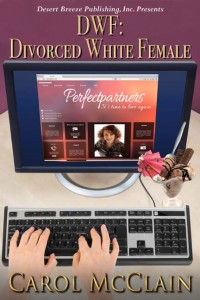 If you love humor and believe in redemption, DWF: Divorced White Female, is fantastic.
Blurb: If you think you’ve experienced a mid-life crisis, Cheryl Chandler will prove you wrong. Ditched by a philandering husband, rearing three weird teens (and a toddler—her failed attempt to save her marriage), she knows only one thing will redeem her life: a man—any man so long as he’s hot.
But how does a forty-something divorcé do that?
The kids have the answer. Go online.
After meeting a string of weirdoes, Tarrant LeClerc befriends her. But he’s too religious, and will only chat with him as a friend.
Then, when she knows this online dating is doomed, she meets the man of her dreams. Smart, witty and enchanting, Carleton Seymour sweeps her off her feet, but he’s got to meet the kids. Cheryl refuses to hide them—although the thought is tempting.
First there’s New Age Andi who changes college majors more frequently than a yogi changes poses. Bobbie’s OCD could drive Mother Teresa nuts. Taylor, once an adolescent drug mule and now born again teen, fears all will forget they’re sinners. And of course, Marina, the toddler, will make her presence known.
It’s available at B&N and Amazon and at Desert Breeze Publishing.
amzn.to/1fZOm4X
http://bit.ly/1NNQ9a5
On September 11, Waters of Separation will be available.
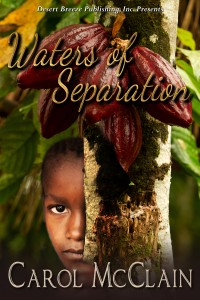 Blurb: Africa’s secrets resurrect the despair physician assistant Anna Haas buried in America. Her pregnancy and the discovery of boys bound by slavery in the cacao sector of the Côte d’Ivoire revive her childhood guilt. Her mother’s suicide claimed the lives of the two small sisters Anna had vowed to protect.
Her failure to save them was unforgiveable.
It will not happen with these boys.
Her interference prompts a corrupt government to threaten the thriving mission and the lives of Anna and her friends. Her action also threaten her marriage.
However, doing nothing will destroy her.
The story weaves from past to present and across two continents as Anna fights for love, faith and redemption.



Great interview. Carol, I know how interesting your are and now everyone else knows too. Did I also mention ‘quirky’?
Thanks, Nike, you’ve been a faithful friend.
Great interview…true to your stylistic humor which I love. Can’t wait to see Waters in print. Anyone reading this comment…get the book…it’s great! So is DWF!
Linda, you are so faithful. Thank you.